
Best Sling Bag for Urban Commuters: 2026 Guide
Table of Contents
- What to Look for in a Sling Bag for Urban Commuters
- Sling Bag vs Backpack for Urban Commute
- How to Organize a Sling Bag for Commuting
- Best Tactical Sling Bag for Everyday Carry
- Comfort and Strap Ergonomics for All-Day Wear
- Material Durability and Weather Resistance
- Style, Sustainability, and Professional vs Casual Use
- Conclusion
- Frequently Asked Questions
Last Updated: October 2, 2026
What to Look for in a Sling Bag for Urban Commuters
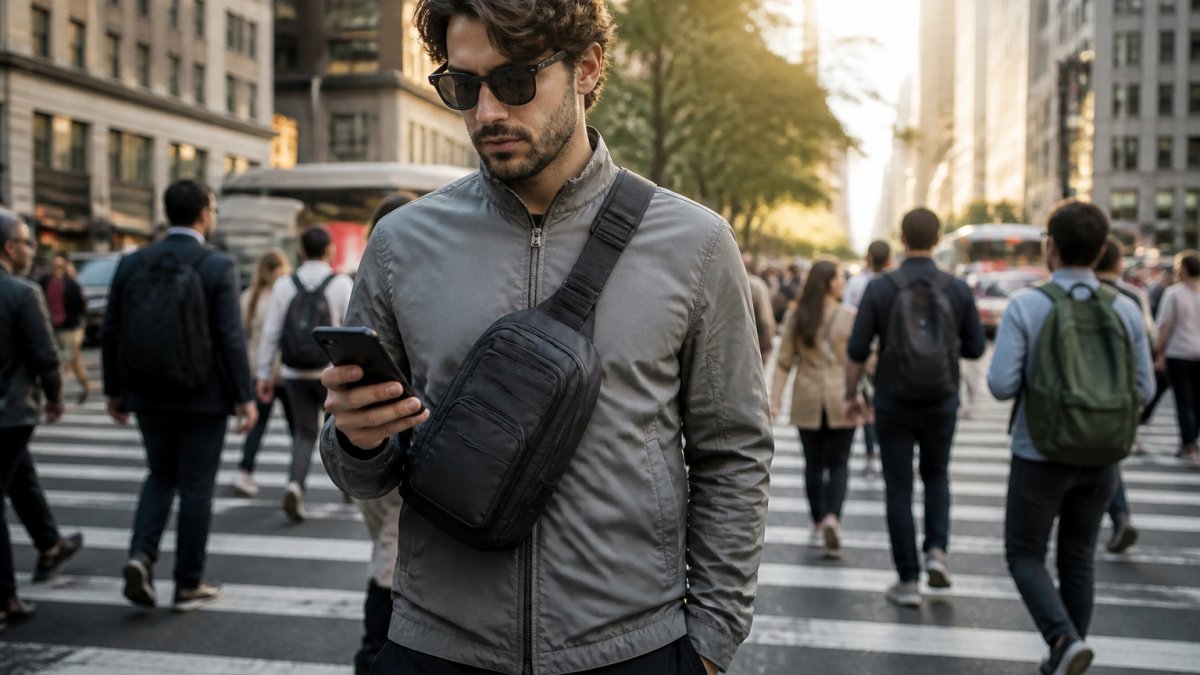
The best sling bag for urban commuters balances three things: quick access to essentials, secure carry in crowds, and all-day comfort. Most commuters don't need more space, they need smarter space.
Urban commuting means moving through crowds, squeezing into carriages, and switching between walking, cycling, and standing. The bag has to keep up without becoming a burden.
What separates a bag that works from one that annoys you by week two:
- Capacity in liters: 6-12 liters suits most commuters. Enough for a tablet, water bottle, and a light layer.
- Quick-access design: You should reach your phone or transit card without stopping or unzipping three compartments.
- Strap ergonomics: A wide, padded strap distributes weight. Thin straps cut into your shoulder on longer walks.
- Security features: Concealed zippers and lockable pulls matter more than you'd think in dense crowds.
- Material durability: Water-resistant fabric and quality zippers determine whether the bag survives a full year of daily use.
Quick Comparison: Key Features at a Glance
Feature |
What to Look For |
Why It Matters |
|---|---|---|
Capacity |
6-12 liters |
Fits daily essentials without bulk |
Strap |
Wide, padded, adjustable |
Prevents shoulder strain |
Access |
Quick-release buckle |
Reach essentials in seconds |
Security |
Concealed or lockable zippers |
Deters pickpockets in crowds |
Material |
Water-resistant, abrasion-resistant |
Handles rain and daily wear |
Sling Bag vs Backpack for Urban Commute
A sling bag wins for urban commutes when you need fast access, hands-free mobility, and a compact profile. A backpack makes sense for heavier loads or a laptop plus gym gear.
When a Sling Bag Wins
Sling bags shine in tight, fast-moving environments: swing to chest, grab what you need, keep moving. No stopping, no taking the bag off, no fumbling.
They work best when:
- Your load is light to moderate (a tablet, not a full laptop setup)
- You switch between walking, transit, and cycling
- You want a minimalist, low-profile look
- You're in crowded spaces and want your valuables in front of you, not behind
For commuters who value urban mobility and quick access, a crossbody sling is the more efficient tool.
When a Backpack Still Makes Sense
Backpacks carry more weight more comfortably across both shoulders. If you haul a heavy laptop, gym clothes, and lunch, their weight distribution is hard to beat.
The trade-off is access: you can't reach into a backpack without taking it off, and in a crowd your valuables sit behind you, out of sight.
A common mistake is buying a sling for a load it was never designed to carry. Match the bag to the load.
How to Organize a Sling Bag for Commuting
Organizing a sling bag comes down to one rule: put what you touch most where you can reach it without looking. Everything else gets a fixed home so you never dig for it.
Here's a layout that works for most commuters:
- Front quick-access pocket: Phone, transit card, keys. This is your one-second zone.
- Main compartment, top: Wallet and small essentials you grab at the counter.
- Main compartment, center: Tablet or notebook, secured with an internal divider.
- Back panel pocket: Passport, spare cash, or anything you want flat against your body.
- Side or strap pocket: Water bottle or a compact umbrella.
The goal is compartmentalization you can trust. When every item has a home, you stop patting your pockets and start moving faster.
Best Tactical Sling Bag for Everyday Carry
The best tactical sling bag for everyday carry pairs rugged materials with low-profile organization, and fits the tech you actually carry. Tactical doesn't mean bulky or military-looking; it means built to take abuse and keep gear secure.
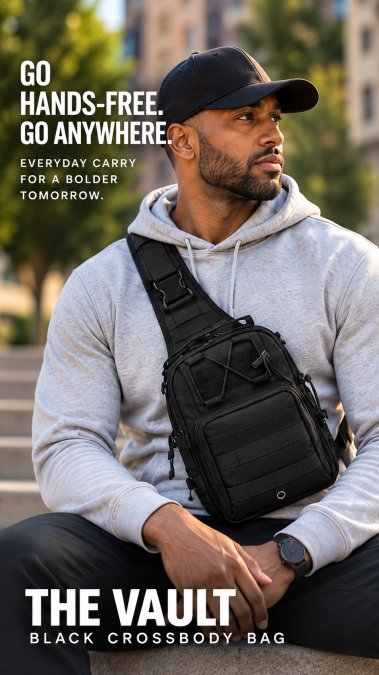
VentureVault.Shop offers a collection of tactical crossbody bags designed for everyday adventure and hands-free convenience. Our durable sling backpacks, including The Sentinel, The Stealth, and The Vault, provide a functional and stylish solution for carrying your essentials on the go. Built for versatility, these bags are the perfect companion for those who need to stay mobile and organized in any environment.
Tech Fit: Measure Before You Buy
Most EDC guides wave at "tablet or e-reader" and move on. That's how commuters end up with a bag that swallows a phone but pinches an iPad Mini.
Common device footprints to check against a bag's main compartment:
- iPad Mini (6th gen and later): roughly 7.7 × 5.3 inches, fits most 6-8L slings with a padded sleeve.
- Kindle Paperwhite: roughly 6.9 × 4.9 inches, usually slides into a front or rear flat pocket.
- 10.9-inch iPad Air: roughly 9.7 × 7 inches, needs a 10L+ sling with a dedicated tablet sleeve; most 6L bags will not close cleanly over it.
- Anker 737-class power bank: roughly 6.1 × 2.1 inches, heavy enough that it should ride in the back panel, not the front pocket, or it will pull the bag forward.
- Nintendo Switch (OLED): roughly 9.4 × 4 inches with Joy-Cons attached, fits a 10L sling, tight in a 6L.
A practical rule: add roughly half an inch of clearance on every side for a case or sleeve.
Anti-Theft Mechanisms, Tested in Practice
Security claims are easy to print and hard to verify. Test a tactical EDC sling's mechanisms yourself before trusting them on a crowded platform:
- Zipper pull locking: Look for pulls that clip to a D-ring or accept a small TSA-style combination lock. A standard YKK zipper with a locking pull resists casual opening far better than an open slider.
- Concealed zipper channels: Zippers tucked under a fabric lip are harder to find by feel in a crowd. Run your hand along the bag in a dark room, if you can't locate the main zipper by touch, a pickpocket can't either.
- Slash-resistant panels: Some bags use woven aramid or HDPE-lined fabric on the body-facing panel. This is not standard on most slings; if a brand claims it, ask which panel and confirm the material name.
- Wear-it-forward routing: The single most effective anti-theft feature is carry position. Worn across the chest, the main compartment and its zippers face you, not the crowd.
What Sets a Tactical EDC Sling Apart
- Abrasion-resistant fabric that survives scraping against train doors and walls
- Reinforced stitching at stress points like strap anchors and zipper ends
- Modular attachment points for adding or removing pouches as your needs change
- Ambidextrous strap routing so left- and right-handed carriers both get quick access
- A back panel pocket sized for a passport or spare cards, flat against your torso
For commuters who also hike on weekends, this is where a tactical sling earns its place: one bag handles the train on Monday and the trail on Saturday, provided the internal dimensions match the gear you carry on both.
Comfort and Strap Ergonomics for All-Day Wear
Comfort comes down to weight distribution, not padding alone. A sling that digs into your shoulder usually has a strap that's too narrow or a load too heavy for the design.
What to look for in strap ergonomics:
- A wide, padded strap that spreads pressure across a larger area
- Breathable mesh on the body-facing side to reduce sweat on warm commutes
- An adjustable strap you can tighten for cycling and loosen for walking
- A quick-release buckle for taking the bag on and off without wrestling with it
A common mistake is overloading a sling and blaming the strap. If your shoulder aches after an hour, the bag is carrying more than it was built for, move heavy items to a backpack or lighten your load.
Material Durability and Weather Resistance
Durability is measured in zippers, stitching, and fabric, in that order. A bag with premium fabric and cheap zippers still fails first at the zipper.
What holds up over a year of daily commuting:
- Water-resistant or weatherproof fabric with a durable water-repellent finish
- Quality zippers that glide smoothly and resist jamming
- Abrasion-resistant panels at the base, where bags get set down
- Reinforced stress points at strap anchors and compartment seams
For commuters in wet climates, water resistance matters more than outright waterproofing most days.
The thing nobody tells you about durability is that zipper quality is the real test. If the zipper feels gritty or catches, the rest of the bag won't matter.
Style, Sustainability, and Professional vs Casual Use
Style determines whether a bag works for the office and the weekend. A sling that reads too tactical looks out of place in a business setting, while a plain one may feel too soft for outdoor use. The useful question is which design signals push a bag toward one end of that spectrum, and how to pick one that crosses both.
The Professional-to-Casual Spectrum
Think of sling bags on a line from boardroom to trailhead. Where a bag lands depends on four visible signals:
- Color: Black, charcoal, navy, and olive read professional. Coyote brown, camo, and high-contrast orange read tactical or outdoor.
- Hardware: Matte black or gunmetal zippers and buckles blend in. Shiny metal, visible MOLLE webbing, and Velcro patch panels signal tactical use.
- Silhouette: A flat, rectangular profile with minimal external pockets reads business-casual. A rounded, bulging profile with side compression straps reads sporty.
- Branding: Small, tonal logos disappear into an office outfit. Large embroidered logos or morale patches do not.
A bag that hits the middle, neutral color, matte hardware, flat profile, minimal branding, walks into a Monday meeting and onto a Saturday trail without looking borrowed from either.
Matching the Bag to the Outfit
A quick decision guide for commuters who want one bag to do both jobs:
- Business-casual office, light carry: A 6-8L sling in black or charcoal with concealed zippers and no external webbing. Worn across the chest or slung to the back, it disappears under a jacket.
- Creative or startup office: A slightly larger 8-10L sling in navy or olive with one visible pocket is fine; the extra capacity handles a tablet and notebook.
- Office plus gym: A 10-12L sling with a separate shoe or laundry compartment. Accept that this size reads more casual and pair it with casual office attire.
- Office plus weekend hike: A 10L sling in olive or charcoal with abrasion-resistant panels and matte hardware. This is the true crossover size.
Sustainability: What to Actually Look For
Sustainability in bags is mostly about longevity, but material sourcing matters too. A few concrete things to check:
- Recycled fabrics: Look for rPET (recycled polyethylene terephthalate) or recycled nylon in the spec sheet. Brands that use it usually name the percentage, for example, "100% recycled 500D nylon", rather than saying "eco-friendly."
- Repairability: Does the brand sell replacement zipper pulls, buckles, or straps? A bag with replaceable hardware outlasts one that has to be thrown out when a single buckle cracks.
- Bluesign or equivalent certification: This is a textile-industry standard for reduced chemical use in manufacturing (bluesign Celebrates 25 Years as a Global Leader in Sustainable Textile Innovation). It is not universal, but its presence is a concrete signal rather than a marketing claim.
- Warranty length: A lifetime or multi-year warranty is the brand's own bet on durability. Treat it as a proxy for how long the bag is expected to last.
Long-lasting gear is the most sustainable gear: buy it once instead of replacing it yearly. For commuters who want one bag for both worlds, a versatile, understated sling beats a specialized one you can only wear on weekends, and keeps more material out of landfills.
Conclusion
The hardest part of choosing a sling bag isn't finding features. It's finding one bag that handles a crowded train, a rainy walk, and a weekend hike without falling apart or looking out of place.
VentureVault.Shop builds tactical crossbody bags for exactly this kind of everyday adventure. The Sentinel, The Stealth, and The Vault combine hands-free crossbody carry, durable tactical construction, and interest-free installment payment options.
Get started with VentureVault.Shop and carry your essentials hands-free, wherever the day takes you.
Frequently Asked Questions
What features should I look for in an urban commuter sling bag?
Prioritize quick-access compartments, a padded back panel, and an ambidextrous strap that switches shoulders without twisting. Look for water-resistant fabric, quality zippers, and internal dividers sized for your phone, wallet, and transit card. If you carry a tablet or compact laptop, check the liter capacity and sleeve dimensions first. Anti-theft details like concealed zippers and a quick-release buckle help in crowded transit. VentureVault.Shop's sling bags are built with tactical organization and hands-free crossbody wear in mind.
Are sling bags better than backpacks for city commuting?
For short commutes and minimalist carry, sling bags win on quick access and hands-free mobility. You can swing the bag to your chest to grab a transit card without removing it. Backpacks still hold more volume and distribute heavier loads better across two shoulders. If your daily carry stays under about 10 liters and you value fast access over maximum capacity, a sling bag is the better fit. For laptops over 15 inches or gym gear, a backpack remains practical.
How do I choose the right size sling bag for my daily essentials?
Measure your largest daily item first, usually a tablet, compact laptop, or water bottle. Sling bags typically range from 2 to 12 liters. A 2-4 liter bag fits phone, wallet, keys, and a power bank. A 5-8 liter bag adds a tablet, small notebook, and light layer. Anything above 10 liters starts to feel bulky on one shoulder. Match the capacity to your actual load, not the maximum you might carry once a month.
What makes a sling bag tactical and is it good for commuting?
A tactical sling bag uses abrasion-resistant materials, modular attachment points, and compartmentalization designed for organized gear access. For commuting, the benefits are durability, structured pockets that keep items from shifting, and often better security features. The trade-off is weight; tactical bags can run heavier than minimalist nylon slings. If you want one bag that handles a daily train ride and a weekend hike, a tactical sling bag for everyday carry covers both without looking out of place in an office.