
Why Crossbody Bags Cause Shoulder Pain | VentureVault.Shop
Table of Contents
- Why Crossbody Bags Cause Shoulder Pain: The Mechanics
- How to Wear a Crossbody Bag Comfortably
- Sling Bag vs Crossbody Bag Comfort: Which Is Better?
- How to Adjust a Sling Bag Strap for Maximum Comfort
- Heavy Bag Shoulder and Neck Pain: When to Seek Help
- Choosing the Right Crossbody Bag to Prevent Pain
- Conclusion: Carry Smarter, Not Harder
- Frequently Asked Questions
Last Updated: October 8, 2026
Why Crossbody Bags Cause Shoulder Pain: The Mechanics
Crossbody bags cause shoulder pain because they load weight on one side, forcing your spine, neck, and shoulder muscles to fight a constant pull that builds up fast on long walks.
At VentureVault.Shop, we build gear for people who move all day, so we hear this complaint a lot.
How Asymmetric Loading Affects Your Body
Asymmetric loading is what happens when weight sits on one side instead of being split evenly. A single strap creates a diagonal pull across your chest and back, tilting your neck, rolling your shoulder forward, and curving your spine to compensate.
The result is a chain reaction:
- One shoulder takes the full load
- Your neck muscles tense to keep your head level
- Your lower back leans to counterbalance
Many people blame the bag's weight alone, but strap position and contact width matter just as much, a thin strap on a heavy bag digs in hardest.
How to Wear a Crossbody Bag Comfortably
You can wear a crossbody bag comfortably by treating it like adjustable gear, not a fixed accessory. Bring the load close to your center of gravity, spread pressure over a wide area, and change the load pattern before fatigue sets in.
At VentureVault.Shop, we build tactical crossbody bags and sling backpacks for all-day movement, so we test these adjustments constantly. Here is a step-by-step system for commuting, hiking, or running errands.
Step 1: Set the bag height first
A crossbody bag should rest at hip level or just above it, roughly the top of your hip bone. If it hangs at mid-thigh, every step creates a pendulum swing that yanks on your shoulder and neck, so shorten the strap until the bag sits no lower than your hip crease. Letting it hang low for a "relaxed" look can increase the effective pull on your shoulder by 20-30%.
Step 2: Position the strap across the widest part of your torso
The strap should cross diagonally from one shoulder to the opposite hip, over the widest part of your chest or back, not on top of your shoulder joint. Crossing bone creates a pressure point; crossing muscle and soft tissue spreads the load.
Try these adjustments:
- Shorten the strap so the bag sits at hip level, not mid-thigh.
- Keep the strap flat, not twisted. A twisted strap concentrates force on a narrow edge.
- Switch the bag to your other shoulder every 30 minutes.
Step 3: Use a stabilizer strap if you have one
Many sling bags and tactical crossbody bags include a small stabilizer strap that connects the main strap to the bag body, keeping the bag from sliding forward when you bend or walk fast. If your bag has one, clip it snug, not tight. If it does not, consider a bag that does, especially if you carry more than a phone and wallet.
Step 4: Match the strap width to the load
A strap at least 4 centimetres (about 1.5 inches) wide spreads the load far better than a thin cord, and padded straps absorb pressure. If you carry more than 2 kilograms (4.4 pounds) regularly, a bag with a built-in wide strap is a better investment.
Step 5: Adjust for the activity
A commute involves short walks and sitting; a hike involves hours of walking, elevation changes, and sweat. The same bag can work for both, but the fit should change:
- Commute: Keep the bag snug at hip level. Loosen the strap slightly when sitting so the bag rests on your lap.
- Hike: Tighten the strap so the bag does not bounce. Use the stabilizer strap and hip belt if you have one.
- Travel: Keep the bag in front of you in crowds for security, but switch to your back on long walks to give your shoulder a break.
A note on load weight
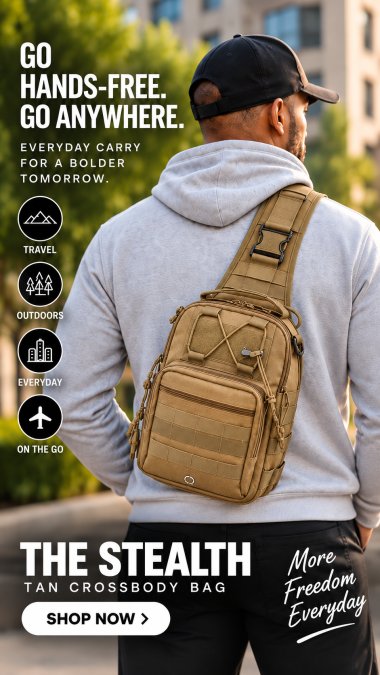
Most practitioners find that keeping a crossbody bag under 10% of your body weight reduces shoulder strain significantly, about 7 kg (15 lb) for a 70 kg (154 lb) person. If you routinely carry more, a sling bag or two-strap backpack distributes the load better. VentureVault.Shop's sling backpacks, including The Sentinel, The Stealth, and The Vault, keep weight centered and close to your body, making them a strong choice for heavier loads.
Quick fit checklist
Before you walk out the door:
- Bag sits at hip level or just above.
- Strap crosses the widest part of your torso, not your shoulder joint.
- Strap is flat, not twisted.
Follow these steps and most shoulder pain from a crossbody bag fades within a few days. If it does not, the next section covers when to seek help.
Sling Bag vs Crossbody Bag Comfort: Which Is Better?
Sling bags often beat crossbody bags on comfort for all-day wear because they sit closer to your back and center the load, while a crossbody bag hangs off one shoulder.
Here is how the two compare:
| Feature | Crossbody Bag | Sling Bag |
|---|---|---|
| Weight placement | One shoulder, hangs low | Centered on back or chest |
| Pressure points | Single strap across chest | Spread across torso |
| Best for | Quick errands, light loads | All-day carry, heavier loads |
| Access | Easy front reach | Rotate to front to open |
| Stability while walking | Swings more | Stays close to body |
For commuters and hikers carrying gear for hours, a sling design usually wins, it keeps the load tight and reduces the swing that strains your neck.
How to Adjust a Sling Bag Strap for Maximum Comfort
Adjusting a sling bag strap for comfort means setting the bag high on your back, keeping the strap snug but not tight, and using a stabilizer strap if your bag has one, a fit that moves with you, not against you.
Start with the bag centered between your shoulder blades and pull the strap until it sits flat against your back.
Check these points:
- The bag should not bounce when you walk
- The strap should lie flat, never twisted
- Your shoulders should stay level, not tilted
A snug sling bag distributes weight across your whole back, taking pressure off any single shoulder and cutting the neck strain that builds over a long day.
Heavy Bag Shoulder and Neck Pain: When to Seek Help
Heavy bag shoulder and neck pain is usually a strain that eases once you change how you carry the load, but some signs mean you should see a doctor.
Watch for these red flags:
- Pain that lasts for days after you stop carrying the bag
- Numbness or tingling in your arm or fingers
- Weakness in your shoulder or hand
Those symptoms can point to nerve compression, not just muscle strain, a heavy bag worn the same way daily can press on nerves near the shoulder and collarbone.
Choosing the Right Crossbody Bag to Prevent Pain
The right crossbody bag to prevent pain matches your actual load, body size, and daily route, not just one with a wide strap. Most guides list features but skip the decision framework for whether a crossbody bag is even right for you.
At VentureVault.Shop, we build tactical crossbody bags and sling backpacks for people who move all day.
Step 1: Estimate your typical load
Before you look at features, weigh what you actually carry, a kitchen scale works fine. Common load ranges:
- Light (under 1 kg / 2.2 lb): Phone, wallet, keys, small water bottle. A crossbody bag is fine.
- Medium (1-3 kg / 2.2-6.6 lb): Add a tablet, notebook, light jacket, lunch. A crossbody bag with a wide strap can work for short periods, but a sling bag is more comfortable for all-day carry.
- Heavy (over 3 kg / 6.6 lb): Laptop, gym clothes, groceries, camera gear. A crossbody bag will likely cause pain. Switch to a sling bag with a stabilizer strap or a two-strap backpack.
If your load varies, choose a bag that handles the heaviest load you carry regularly, not the lightest.
Step 2: Match the bag type to your activity
Use this decision framework:
| Your situation | Recommended bag type | Why |
|---|---|---|
| Short commutes (under 30 min), light load | Crossbody bag with wide strap | Easy access, enough for essentials |
| Long commutes (over 30 min) or all-day walking | Sling bag with stabilizer strap | Keeps load centered, reduces swing |
| Hiking or uneven terrain | Sling bag or small backpack with hip belt | Hip belt transfers weight off shoulders |
| Mixed commute + hike in one day | Sling bag with compression straps | Can tighten for trail, loosen for office |
| Heavy work gear (laptop + tools) | Two-strap backpack | Even load distribution across both shoulders |
If you often switch between commuting and hiking, a sling bag with a stabilizer strap and snug fit is the most versatile single-bag option, tighten it for the trail, loosen it for the office.
Step 3: Check these specific features
When comparing bags, prioritize these:
- Strap width: At least 4 cm (1.5 in). Padded is better.
- Stabilizer strap: A must for any load over 2 kg (4.4 lb).
- Bag height when worn: Should sit at hip level, not mid-thigh. Check the strap length range.
- Back panel: A slightly padded, breathable panel keeps the bag from sliding and reduces sweat.
- Compartment layout: Heavy items (water bottle, laptop) should sit closest to your body, in a separate compartment if possible.
- Weight of empty bag: Lighter is better. A bag that weighs 1 kg empty adds to your load before you put anything in it.
Step 4: Consider capacity for real use cases
Capacity is often described vaguely as "ample" or "spacious." Practical volume ranges:
- 2-4 litres: Phone, wallet, keys, small water bottle. Good for minimal carry.
- 5-8 litres: Add a tablet, notebook, light jacket, lunch. Good for commuting.
- 9-12 litres: Add a laptop (up to 14 inches), gym clothes, larger water bottle. Good for work + gym.
To carry a laptop and hiking gear in one bag, look for a sling bag in the 10-15 litre range with a padded laptop sleeve and a separate compartment for wet or dirty items.
Step 5: Know when to choose one bag versus two
A single bag can work for both commuting and hiking if your commute is under 30 minutes each way, your hike is a day hike on maintained trails, your work gear fits in a 15-litre bag or less, and you are willing to repack between uses. Choose two bags if you carry a laptop larger than 14 inches, hike rugged or wet terrain regularly, need specialized gear (camera, climbing equipment) that does not fit with work items, or commute by bike or crowded transit where a sling bag is easier to manage.
Step 6: Test the fit before you commit
When your bag arrives, load it with your typical gear and wear it for 10 minutes at home. Check whether the strap digs into your shoulder or neck, the bag swings when you walk, you can switch sides easily, and the bag stays at hip level. If any answer is no, adjust the strap or return the bag, a bag that hurts in the first 10 minutes will hurt more after an hour.
By following this framework, you can choose a bag that prevents pain instead of causing it, and you will know when to switch carry styles. VentureVault.Shop offers interest-free installment options on our tactical sling backpacks, so you can upgrade without straining your budget.
Conclusion: Carry Smarter, Not Harder
Shoulder pain from a crossbody bag is a fit problem, not a fact of life. Fix the strap, raise the bag, and switch sides often, and most of the ache goes away.
If you want a bag built for all-day carry, VentureVault.Shop has you covered. Our crossbody and sling bags offer a wide padded strap, a snug tactical fit, and hands-free convenience for commutes, hikes, and travel.
Frequently Asked Questions
Why does wearing a crossbody bag make my shoulder hurt?
Crossbody bags concentrate weight on one shoulder, pulling your body out of alignment. This uneven load strains your shoulder, neck, and upper back muscles. Over time, the constant pressure can cause pain and fatigue. To reduce this, adjust the strap so the bag sits at hip level, keep the load light, and switch sides regularly. VentureVault.Shop offers ergonomic crossbody bags designed for better weight distribution.
Can a heavy crossbody bag cause shoulder and neck pain?
Yes, a heavy crossbody bag can lead to shoulder and neck pain. The weight pulls on your shoulder, causing you to lean to the opposite side to compensate. This misalignment strains your neck and upper back. To prevent pain, keep your bag under 10% of your body weight, use a wide strap, and consider a bag with a hip belt to transfer weight. VentureVault.Shop's tactical crossbody bags are built for comfort even with heavier loads.
How should a crossbody bag fit to reduce shoulder strain?
A crossbody bag should sit at your hip, not your waist or lower back. The strap should be wide and padded to distribute pressure. Adjust the length so the bag rests comfortably without bouncing. The bag should be snug against your body but not tight. VentureVault.Shop's adjustable straps let you find the perfect fit for all-day wear.
Are sling bags more comfortable than crossbody bags?
Sling bags often provide better comfort because they distribute weight across your back and shoulder, rather than just one shoulder. They also keep the bag secure against your body, reducing bounce. Crossbody bags can be comfortable if worn correctly, but sling bags are generally more ergonomic for heavier loads. VentureVault.Shop offers both styles, so you can choose what works best for your needs.